Towing Over 5,000 lbs? Your Truck Needs LT Tires, Not P-Metric
 Telle Tire 15 min read
Quick Answer
LT tires are generally better suited for regular heavy towing, but the right choice depends on your truck’s factory specifications, axle ratings, and tire load capacity.
In This Article
- What Are LT Tires and P-Metric Tires?
- LT Tires vs. P-Metric Tires: What’s the Difference?
- Why LT Tires Are Often Better for Heavy Towing
- When Are P-Metric Tires Suitable for Towing?
- How to Choose the Right Truck Tires for Towing
- Best Truck Tires for Towing: What Should You Look For?
- When Should You Have Your Truck Tires Inspected?
What Are LT Tires and P-Metric Tires?
Not all truck tires are built for the same type of work. Some are designed primarily for everyday driving, while others are engineered to handle heavier loads, tougher surfaces, and more demanding operating conditions.
Two common tire classifications you’ll find on pickup trucks are LT and P-Metric.
What Are LT Tires?
LT stands for Light Truck. These tires are designed for light trucks, including pickups, vans, and certain SUVs that need additional load-carrying capability or more robust construction.
LT tires typically have reinforced internal construction to handle demanding applications. Depending on the model and load range, they may offer:
- Greater resistance to impact and damage in demanding conditions.
- Construction designed for heavier payloads.
- Options suited for towing, hauling, and commercial use.
- Greater resistance to cuts and chips in certain all-terrain applications.
LT tires are available in different load ranges, such as C, D, and E. Each has specific load and inflation limits.
However, an LT designation alone does not tell you how much weight a tire can carry. You must check its actual load rating and the manufacturer’s load-and-inflation information.
What Are P-Metric Tires?
P-Metric tires are passenger-type tires commonly used on cars, crossovers, SUVs, and some light-duty pickup trucks.
The letter “P” often appears before the tire size on the sidewall. For example, P265/70R17 identifies a passenger-metric tire. However, many newer half-ton trucks leave the factory with Euro-Metric passenger tires (such as 275/65R18, with no letter in front of the numbers), which follow the same passenger-tire standards and towing rules.
These tires are generally designed to provide a comfortable ride, responsive handling, and suitable load capacity for their intended applications.
Some pickup trucks leave the factory with P-Metric tires because the manufacturer determined they meet the vehicle’s original requirements.
P-Metric tires aren’t automatically unsuitable for towing. Their ability to handle a particular load depends on their specifications, inflation pressure, and the vehicle’s requirements.
LT Tires vs. P-Metric Tires: What’s the Difference?
The main differences involve construction, load ratings, inflation requirements, and intended applications.
Here’s how they compare:
| Feature | LT Tires | P-Metric Tires |
|---|---|---|
| Primary application | Light trucks and demanding loads | Passenger vehicles and some light trucks |
| Construction | Generally more robust for demanding use | Designed around passenger-vehicle requirements |
| Load capacity | Varies by size, load range, and pressure | Varies by size, load index, and pressure |
| Inflation requirements | Often require higher pressure to carry equivalent loads | Generally operate at lower pressures |
| Ride comfort | Can feel firmer | Generally offer a more comfortable ride |
| Common applications | Towing, hauling, work trucks, off-road use | Daily driving and lighter-duty applications |
One important distinction is that LT tires don’t automatically carry a higher raw number on the sidewall than every P-Metric tire. An LT tire in one size and load range may list a lower max load than a larger P-Metric tire.
However, Federal Motor Vehicle Safety Standards (FMVSS) and Tire and Rim Association (TRA) guidelines require P-Metric tires on light trucks and SUVs to be derated by roughly 10% (i.e., divided by 1.1) to account for higher centers of gravity and heavier hauling demands. LT tires do not face this reduction, making their full rated load capacity available for towing and payload.
Switching to LT tires doesn’t increase the truck’s own maximum payload or towing capacity. The vehicle’s factory ratings still apply.
Why LT Tires Are Often Better for Heavy Towing
Towing adds weight to your truck through the trailer hitch, passengers, and cargo. Properly selected LT tires can help handle these additional demands.
1. Designed for Demanding Loads
LT tires are built for light trucks that carry heavier loads and handle demanding conditions. Their construction can provide additional support for trucks that regularly tow campers, boats, or equipment trailers.
However, always check the tire’s actual load rating against your vehicle’s requirements.
2. Better Suited to Rough Road Conditions
Some LT tires feature reinforced construction and tread compounds designed to resist cuts, chips, and impacts. These features can benefit trucks frequently traveling on gravel roads, construction sites, and uneven surfaces.
Durability varies by tire model, so choose one suited to your driving conditions.
3. More Tread Options for Different Towing Needs
LT tires come in different tread designs for various driving conditions:
- Highway-terrain: Primarily designed for paved roads and highway driving.
- All-terrain: Balances highway performance with traction on gravel and dirt roads.
- Mud-terrain: Designed for more aggressive off-road conditions.
Consider your trailer type, towing frequency, and typical driving surfaces when choosing a tread design.
4. Better Fit for Some Heavy-Duty Trucks
Some trucks come equipped with LT tires because their intended use requires specific load and durability characteristics.
Replacing factory LT tires with P-Metric tires without checking load requirements can reduce available tire capacity. Always consult the vehicle specifications and tire load and inflation tables before switching.
When Are P-Metric Tires Suitable for Towing?
A pickup doesn’t necessarily need LT tires just because it pulls a trailer.
Some half-ton trucks are designed to use P-Metric tires, including certain factory configurations intended for towing.
If the original tires meet the manufacturer’s load requirements and the truck stays within its rated limits, an appropriate P-Metric replacement may remain suitable.
Consider these situations:
- Occasional light towing: A properly equipped truck may handle smaller trailers with its original P-Metric tires.
- Daily commuting with occasional towing: P-Metric tires may provide the ride comfort and handling the vehicle is intended for.
- Factory-approved P-Metric setup: If the manufacturer specifies P-Metric tires and the tires meet the required load capacity, switching to LT tires isn’t automatically necessary.
The important thing is to avoid choosing tires based on trailer weight alone.
A truck rated to tow 7,000 lbs, for example, doesn’t necessarily place 7,000 lbs on its own tires. The trailer carries much of its weight on its own axles, while the hitch transfers a portion to the truck.
That transferred weight, combined with passengers and cargo, affects the truck’s available payload and axle loads.
How to Choose the Right Truck Tires for Towing
Choosing towing tires involves more than finding a tire with a higher load range.
Start with the truck’s specifications and work from there.
1. Check the Original Tire Specifications
Look at the tire information placard on the driver’s door jamb.
It lists the original tire size and recommended cold inflation pressure. Your owner’s manual may also provide information about approved replacement tires.
Check whether the original tires are P-Metric or LT.
When replacing tires, make sure the new set meets the vehicle manufacturer’s requirements for size, load capacity, and appropriate speed rating..
2. Understand Your Truck’s Payload and Axle Ratings
Two important numbers to understand are GVWR and GAWR.
- GVWR (Gross Vehicle Weight Rating): The maximum permitted loaded weight of the truck.
- GAWR (Gross Axle Weight Rating): The maximum permitted weight supported by an individual axle.
Your payload includes passengers, cargo, accessories, and the portion of the trailer’s weight that the truck carries.
For example, adding a heavy trailer tongue load can use up a significant portion of your available payload, especially when the truck also carries passengers and equipment.
Check the driver’s door labels and owner’s manual for the applicable limits.
3. Check the Tire Load Index and Load Range
The load index indicates the maximum load a tire can carry under specified conditions.
LT tires also have load-range designations, commonly C, D, and E.
These designations indicate the tire’s load and inflation capabilities. They aren’t interchangeable with the actual weight capacity listed for a particular tire.
Compare the tire’s specifications with the vehicle’s axle requirements. For a suitable replacement, its load capacity must meet or exceed the required capacity at the applicable inflation pressure.
Telle Tire’s guide to understanding tire load index explains how these markings relate to tire capacity.
4. Set the Correct Tire Pressure for Towing
Proper inflation is especially important when carrying heavy loads.
An underinflated tire flexes more than intended, which can increase heat buildup and contribute to premature wear or tire failure.
An overinflated tire may have reduced contact with the road and wear unevenly.
LT tires often require higher inflation pressures than P-Metric tires to carry equivalent loads. This means you cannot simply use the original P-Metric pressure when switching to an LT tire.
Use the tire manufacturer’s load and inflation tables and the vehicle manufacturer’s requirements to determine the correct pressure for your setup.
Always check tire pressure when the tires are cold.
5. Consider Your Typical Driving Conditions
Think about how you actually use your truck.
Do you tow a camper every weekend? Carry construction materials during the week? Drive mostly on highways or regularly travel over gravel and uneven roads?
These factors help determine which tire construction and tread design make sense.
For example, highway-terrain LT tires may be a practical option for frequent highway towing, while an all-terrain model may better suit drivers who also travel on dirt or gravel roads.
The best truck tires are those that meet your vehicle’s requirements and match your everyday driving conditions.
Best Truck Tires for Towing: What Should You Look For?
There isn’t a single tire that works best for every truck-and-trailer combination.
Instead of choosing based solely on brand or appearance, compare the specifications that directly affect towing performance.
| What to Compare | Why It Matters |
|---|---|
| Load capacity | Must support the actual axle loads |
| Tire size | Must match approved vehicle fitment |
| Load range | Helps identify the tire’s load and pressure capabilities |
| Speed rating | Must meet the vehicle manufacturer’s requirements |
| Tread design | Affects traction, road noise, and handling characteristics |
| Durability | Matters for frequent towing and rough-road use |
| Inflation requirements | Ensures the tire carries the intended load safely |
Also consider the trade-offs. LT tires can feel firmer and may produce more road noise than some passenger-type tires. They can also be heavier, which may affect ride comfort and fuel economy.
A more aggressive tread isn’t necessarily better for highway towing, either. Consider the surfaces you regularly drive on before choosing a tire.
If you’re comparing options, Telle Tire’s tire-buying and installation guide provides additional information on tire specifications and selection.
When Should You Have Your Truck Tires Inspected?
Regular tire inspections help identify problems before they affect your next towing trip.
Pay attention to these warning signs:
- Uneven tread wear across the tire.
- Cracks, cuts, or bulges along the sidewall.
- Repeated loss of tire pressure.
- Vibration or unusual noise while driving.
- Visible damage after hitting a pothole or road debris.
A bulge in the sidewall can indicate internal tire damage. If you notice one, stop driving on that tire and arrange for professional inspection and replacement as needed.
Before a long towing trip, check the tire pressure, tread condition, sidewalls, and spare tire. Also make sure the wheels and tires are properly fitted for the truck.
A professional tire inspection can help determine whether your current tires meet your vehicle’s requirements and are suitable for the loads you regularly carry.
Telle Tire offers tire sales, installation, and tire maintenance to help drivers find the right fit for their vehicles.
Planning a tire upgrade before your next towing trip? Visit a Telle Tire location to discuss your truck’s tire specifications and driving needs.
Frequently Asked Questions
Are LT tires better than P-Metric tires for towing?
LT tires are often better suited to frequent heavy towing because they are designed for demanding light-truck applications. However, the correct choice depends on your truck’s original specifications, axle loads, and tire capacity.
Do I need LT tires if I tow more than 5,000 lbs?
If you tow over 5,000 lbs regularly or carry heavy payloads, LT tires are the recommended choice for durability and stability. While some trucks can technically tow that weight on factory P-Metric tires under light conditions, you should always check your owner’s manual, door-jamb tire placard, and axle weight limits to ensure your tires aren’t being pushed past their safe capacity.
Can I replace P-Metric tires with LT tires?
In some cases, yes. However, the replacement must meet the vehicle’s fitment and load requirements. LT tires may also require higher inflation pressure to carry the same load, so consult the tire manufacturer’s load-and-inflation tables.
What does Load Range E mean on truck tires?
Load Range E identifies a particular tire load and inflation capability. It is commonly associated with the older 10-ply rating terminology, but it does not mean the tire actually has ten plies. Always check the tire’s specific load and pressure ratings.
Do LT tires improve towing stability?
They can provide benefits in demanding loaded applications when properly selected and inflated. However, towing stability also depends on trailer weight distribution, hitch setup, suspension condition, tire condition, and vehicle loading.
Should I inflate LT tires to 80 PSI when towing?
Not automatically. Some Load Range E tires have a maximum pressure of 80 PSI, but that doesn’t mean every truck should use that pressure. Follow the applicable vehicle and tire manufacturer recommendations for your actual load.

Take it to telle
Stay Safe with a Tire Check from Telle Tire
Worried about your tread depth or tire condition heading into the summer storm season? Take it to Telle. Our expert technicians can assess your tires, check pressure levels, and recommend replacements when necessary, helping you stay in control regardless of the weather conditions. Stay safe, stay prepared, and if you’re unsure about your tires, schedule a visit with your nearest Telle Tire & Auto Centers location today.
Stay Informed
Recent Articles from Telle Tire
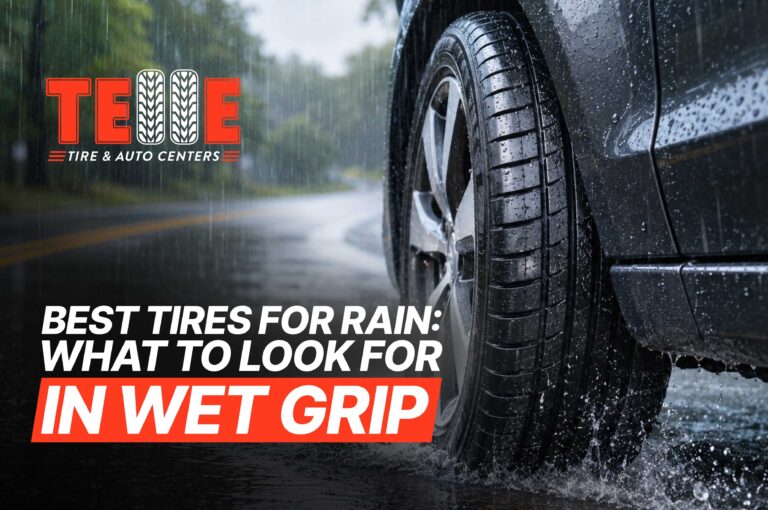
Which Tires Are Safest in the Rain? What to Look For
Learn which tire features improve wet-road traction, help prevent hydroplaning, and keep your vehicle more stable in rainy conditions.
How to Quiet Noisy Tires Without Buying New Ones
Quick Answer You can sometimes quiet noisy tires by correcting tire pressure, alignment, or balancing, or by addressing uneven wear, but severe tread damage may require…
Missouri Tire Maintenance Tips for Better Tire Safety
If you drive regularly in Missouri, your tires deal with a little bit of everything. Hot summer pavement, heavy rain, freezing mornings, changing temperatures, potholes, highway…