AWD Tire Replacement: Can You Replace Just One Tire?
 Telle Tire 13 min read
A flat tire can turn an ordinary day into an unexpected expense, especially when you drive an all-wheel-drive (AWD) vehicle. You might wonder whether you can replace the damaged tire and keep the other three, especially since they still have plenty of tread left.
The answer depends on your vehicle manufacturer’s requirements, the condition of your remaining tires, and how closely a replacement matches the existing set. Proper AWD tire replacement protects your vehicle’s handling and helps prevent unnecessary stress on expensive drivetrain components.
Before buying a replacement tire, learn what to check, when a single tire may be acceptable, and when replacing two or all four tires makes more sense.
TLDR for AWD Tire Replacement
- You may be able to replace one tire. The other three must be in suitable condition, and the replacement must meet your vehicle manufacturer’s requirements for tread depth, size, and rolling circumference.
- Matching tread depth matters. Significant differences in AWD tire tread depth can cause the wheels to rotate at different speeds, potentially placing extra stress on the drivetrain.
- Replacing all four tires is sometimes necessary. If the remaining tires are significantly worn, a complete set may be the safest and most practical option.
- Tire shaving may reduce replacement expenses. A tire professional may be able to shave a new tire to match the existing tires when the manufacturer permits this approach.
- Check before you buy. Consult your owner’s manual and have all four tires inspected before deciding which replacement option suits your vehicle.
Can You Replace Just One Tire on an AWD Vehicle?
Yes, you can sometimes replace one tire on an AWD vehicle, but only when the replacement meets the vehicle manufacturer’s specifications. A single replacement may work when the other three tires have minimal wear and the new tire closely matches their size, construction, model, and rolling circumference.
AWD systems send power to all four wheels, though the way they distribute it varies by vehicle. These systems are designed to accommodate normal differences in wheel speed during turns and changing road conditions. However, a persistent difference in tire diameter can impose additional stress on drivetrain components.
For this reason, replace one tire on AWD vehicles only after confirming that the new tire will remain within the manufacturer’s permitted limits.
Consider these situations before making a decision.
- The other three tires are nearly new. A single replacement may be suitable if the new tire matches the existing tires and meets the manufacturer’s specifications.
- The remaining tires have moderate wear. A new tire may have more tread than the other three. A technician needs to measure all four tires before recommending a solution.
- The other tires have substantial wear. Replacing all four may be the better option if a single replacement cannot meet the required limits.
- The damaged tire has a repairable puncture. A professional tire inspection may reveal that a safe repair is possible, allowing you to avoid replacement altogether.
- The vehicle requires closely matched tires. Some manufacturers impose strict limits on tire circumference or tread differences. Follow the instructions for your specific model and year.
The key is to avoid assuming that every AWD vehicle follows the same rule. A recommendation suitable for one model may not apply to another.
Why Matching Tires on All-Wheel Drive Vehicles Matters
Tires with different tread depths can have slightly different rolling circumferences, even when they share the same size printed on the sidewall. A deeper-tread tire may travel a slightly different distance with each rotation than a more worn tire.
This difference can affect how an AWD system operates. Depending on the vehicle’s design and the size of the mismatch, the drivetrain may experience additional stress that could contribute to premature wear or damage.
Matching tires on all-wheel-drive vehicles helps maintain predictable handling and keeps tire differences within the manufacturer’s specified limits.
How mismatched tires affect your vehicle
- Additional drivetrain stress – Differences in rolling circumference can cause certain AWD components to work harder than intended, potentially increasing wear.
- Uneven power distribution – Some systems may respond to wheel-speed differences by adjusting how power is delivered to the wheels.
- Changes in handling – Tires with different tread depths or traction characteristics may respond differently during braking, cornering, or acceleration.
- Uneven tire wear – A mismatch may complicate tire rotation and make it harder to maintain consistent wear across the set.
- Unexpected repair expenses – Ignoring tire-matching requirements may lead to mechanical problems that cost considerably more to address than a proper tire replacement.
These risks do not mean every small difference will immediately damage your vehicle. The actual consequences depend on the AWD system, the size of the mismatch, and how the vehicle is driven.
What AWD tire tread depth tells you
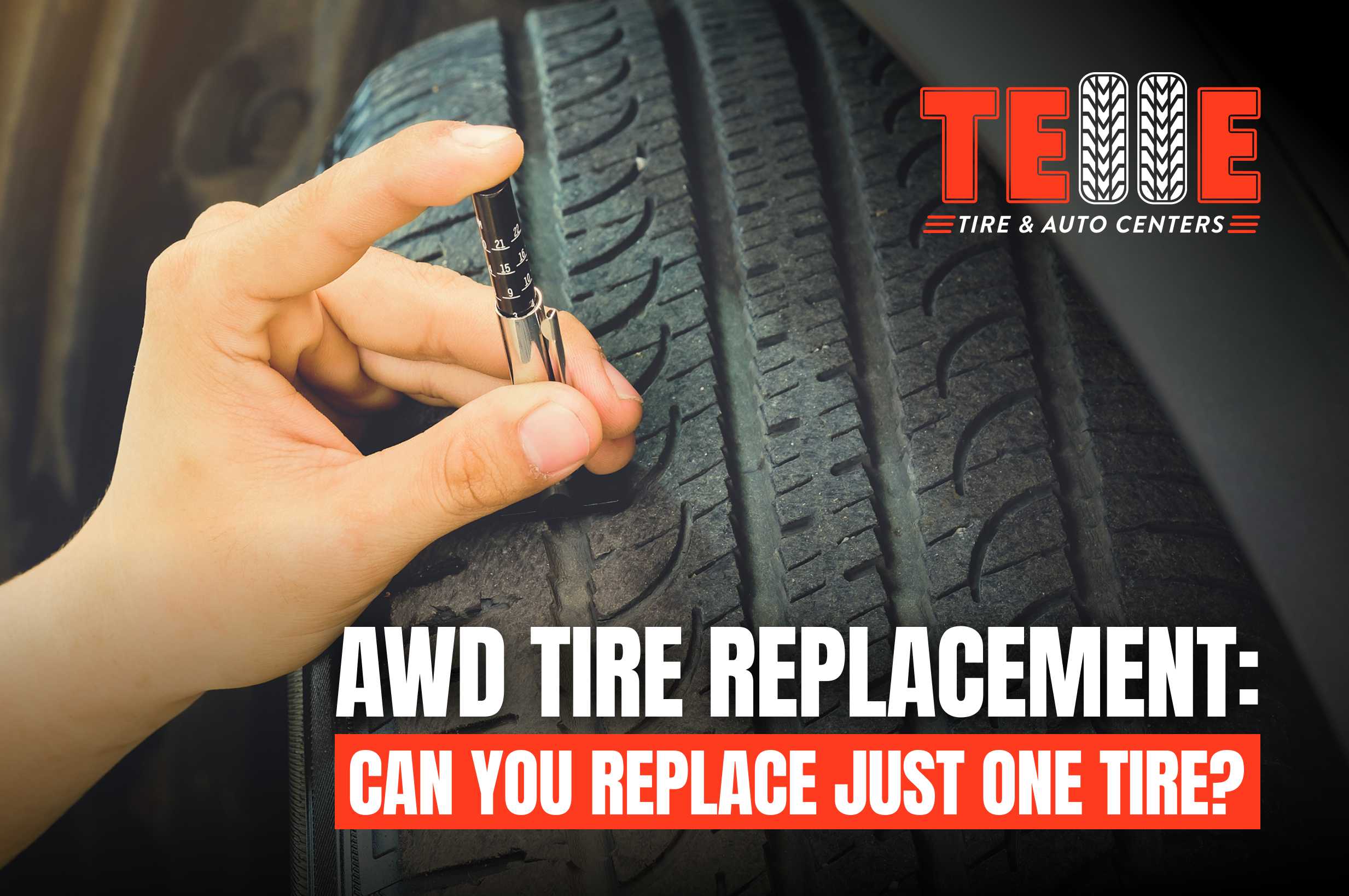
Tread depth measures how much usable tread remains on a tire. It affects traction and can help a technician determine whether a replacement tire is compatible with the other three.
For example, imagine your three remaining tires measure 8/32 inch, while a new tire has 10/32 inch of tread. The difference is 2/32 inch.
That measurement alone does not prove the replacement is safe. Your vehicle manufacturer’s requirements may specify a different limit, and actual rolling circumference can depend on tire construction, wear patterns, and other factors.
A technician should measure several points across each tire rather than relying on one reading. This is particularly important when uneven wear has affected the inner or outer tread edges.
When One Tire Replacement May Be Safe
A single replacement can be a reasonable option when the other tires remain in good condition and the new tire meets all applicable vehicle requirements.
Before approving the replacement, have a tire professional check the following details.
- Tire size – Confirm that the replacement matches the size specified for your vehicle and wheel position.
- Brand and model – Using the same tire model helps maintain similar construction and performance characteristics.
- Tread depth – Measure the remaining tread on all four tires and compare the results with the manufacturer’s limits.
- Load and speed ratings – The replacement must meet the vehicle’s requirements for carrying weight and operating speed.
- Rolling circumference – When required, verify that the replacement’s actual circumference falls within the permitted range.
These checks help determine whether replacing one tire is appropriate or if another option would be safer.
A useful rule is to confirm compatibility before purchasing the tire. If you are trying to replace one tire on AWD vehicles without replacing the complete set, ask the shop to explain the measurements and specifications behind its recommendation.
When You Should Replace Two or All Four Tires
Sometimes a single replacement cannot provide a suitable match. In those cases, replacing a pair or the complete set may be necessary.
The correct choice depends on the amount of wear, tire condition, vehicle design, and manufacturer guidance.
Replacing two tires
Replacing two tires may be possible when the vehicle manufacturer allows it and the resulting four-tire combination meets the required specifications.
For example, if two tires are worn while the other two have similar remaining tread, a matching pair may be a practical solution. However, replacing the front pair or rear pair does not automatically resolve a difference in circumference between the axles.
When two tires are replaced, the shop should also consider the manufacturer’s instructions for tire placement. General tire-industry guidance often recommends installing the tires with deeper tread on the rear axle to support stability on wet roads, but the correct configuration for your vehicle must take priority.
Replacing all four tires
A complete set is often the most straightforward option when the existing tires have substantial wear or cannot meet the manufacturer’s matching requirements with fewer replacements.
Consider replacing all four when:
- The remaining tires are significantly worn.
- The vehicle manufacturer requires all four tires to be replaced together.
- The existing tires have incompatible sizes, models, or specifications.
- Uneven wear or damage makes the remaining tires unsuitable for continued use.
- A single tire or replacement pair cannot meet the required circumference limits.
Although buying four tires costs more upfront, it can provide a consistent set and avoid the difficulty of matching new tires to a worn set.
How to Choose the Most Practical AWD Tire Replacement Option
The best choice balances safety, manufacturer requirements, tire condition, and your budget. A quick inspection can help narrow the options before you commit to a purchase.
Follow these steps when one tire needs attention.
- Check the owner’s manual. Look for the manufacturer’s tire replacement instructions and any specific limits for tread depth or circumference.
- Inspect all four tires. Check for punctures, cuts, bulges, cracks, uneven wear, and other signs that a tire may be unsafe.
- Measure the tread depth. Ask a technician to measure multiple points across each tire and compare the results.
- Confirm the replacement specifications. Match the approved tire size, construction, ratings, and other requirements for your vehicle.
- Compare the available options. Ask whether one tire, a shaved replacement, a pair, or four new tires will meet the manufacturer’s requirements.
- Review the long-term costs. Consider the condition and expected remaining life of the other tires, not only the immediate replacement price.
This process gives you a clearer basis for comparing recommendations. It also helps you understand why a shop might recommend replacing more than one tire.
How Much Does AWD Tire Replacement Cost?
The cost of AWD tire replacement depends on the vehicle, tire size, tire brand, and number of tires that need replacing. A single replacement generally costs less upfront than a pair or a complete set, but the cheapest immediate option may not be the most practical choice.
When comparing prices, look beyond the price printed beside the tire.
- Tire purchase price – Premium tires and larger sizes generally cost more than basic passenger-car tires.
- Installation and balancing – Ask whether mounting, wheel balancing, and related installation services are included.
- Tire shaving – If approved and available, this service may help match one new tire to the existing set.
- Additional repairs – A puncture repair, damaged wheel, or alignment concern may add to the total.
- Future replacement needs – Consider how soon the remaining tires will need replacing and whether buying a complete set now makes better financial sense.
For a fair comparison, request an itemized estimate for each suitable option. This lets you compare the full cost of one, two, or four tires without overlooking necessary services.
The goal is to find an option that meets your vehicle’s requirements while making sensible use of the tires you already own.
Choose the Right AWD Tire Replacement With Telle Tire & Auto Centers
A damaged tire does not automatically mean you need four new tires, but it does call for a careful assessment. The right decision depends on your vehicle’s requirements, the tread remaining on your other tires, and the condition of the complete set.
Telle Tire & Auto Centers can help you evaluate your tire replacement options and determine which solution fits your vehicle’s needs. A professional inspection gives you useful information before you spend money on a single tire or a complete set.
When you need AWD tire replacement, prioritize correct tire matching, safe handling, and the manufacturer’s recommendations. Making the right choice now can help you avoid unnecessary expenses and keep your vehicle performing as intended.
Need help deciding whether to replace one tire or all four? Visit Telle Tire & Auto Centers to discuss your options and arrange a tire inspection.
Schedule your service at Telle Tire & Auto Centers and get guidance on the right replacement for your AWD vehicle.

Take it to telle
Stay Safe with a Tire Check from Telle Tire
Worried about your tread depth or tire condition heading into the summer storm season? Take it to Telle. Our expert technicians can assess your tires, check pressure levels, and recommend replacements when necessary, helping you stay in control regardless of the weather conditions. Stay safe, stay prepared, and if you’re unsure about your tires, schedule a visit with your nearest Telle Tire & Auto Centers location today.
Stay Informed
Recent Articles from Telle Tire
Tire Replacement Cost Guide: What Drivers Should Expect
Replacing your tires is one of those vehicle expenses that can catch you off guard if you only look at the price printed beside the tire.…

How Weather Affects Tires in Tennessee: Tire Care Tips
Tennessee drivers deal with a wide range of weather throughout the year, from hot and humid summer days to heavy spring thunderstorms and occasional winter freezes.…

Best All-Season Tires Springfield MO: Top Buying Tips
Choosing the best all-season tires Springfield MO, drivers can rely on takes more thought than picking the most familiar brand. Springfield drivers deal with hot summer…