Synthetic vs High Mileage Oil and Manufacturer Approvals
 Telle Tire 13 min read
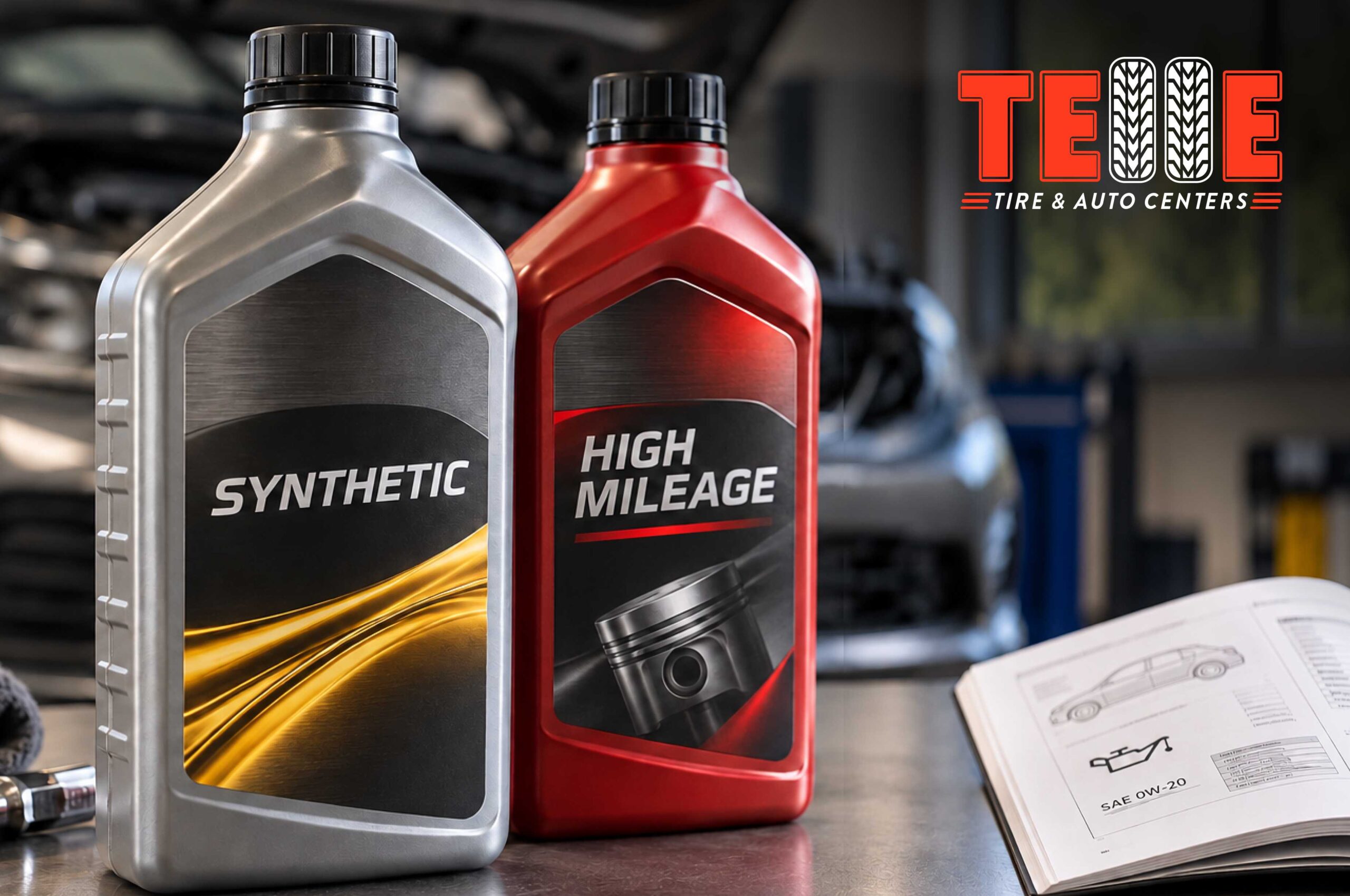
Choosing between synthetic and high-mileage oil can be confusing when both bottles promise engine protection. The most important step is to check your vehicle’s required viscosity and manufacturer specifications before comparing product labels. A high-mileage formula may suit an older engine, while a standard full synthetic may be the correct choice for a vehicle with plenty of miles left to cover.
For drivers visiting Telle Tire & Auto Centers in Affton, Missouri, understanding these differences can help make an oil change more straightforward. The right oil depends on your engine design, documented requirements, condition, and maintenance schedule, not mileage alone.
TL;DR on Synthetic vs High Mileage Oil
- Match the SAE viscosity grade in your owner’s manual before considering other oil characteristics.
- Choose oil that meets the required manufacturer approvals and performance specifications, regardless of its synthetic or high-mileage label.
- Understand that synthetic describes the base oil formulation, while high mileage refers to a product category designed for aging engines.
- Consider oil leaks, consumption, and maintenance history when deciding if a high-mileage formula suits your engine.
- Follow the manufacturer’s recommended service interval because neither synthetic nor high-mileage oil automatically allows longer intervals.
What Is the Difference Between Synthetic and High-Mileage Oil?
Synthetic oil and high-mileage oil describe different characteristics of engine lubricant. Synthetic refers to the base oil formulation, while high-mileage products are marketed for engines with substantial use. These categories can overlap, so a bottle may contain full synthetic high-mileage oil.
| Feature | Full synthetic oil | High-mileage oil |
|---|---|---|
| Main distinction | Base oil formulation | Product category for aging engines |
| Typical intended use | Engines requiring synthetic oil or benefiting from its specified performance characteristics | Older or higher-mileage engines, depending on their condition |
| Available formulations | Full synthetic and other product variations | Conventional, synthetic blend, or full synthetic |
| Main selection criteria | Required viscosity and performance specification | Required viscosity and performance specification, plus the engine’s condition |
| Does the label guarantee compatibility? | No | No |
| Does the label automatically extend oil-change intervals? | No | No |
The table highlights a key point. These are not mutually exclusive choices. A vehicle owner can use a high-mileage product that meets the engine’s full-synthetic requirements, provided its viscosity and specifications are appropriate.
What synthetic oil offers
Full synthetic oil is formulated for demanding lubrication conditions and can provide performance benefits under high temperatures and temperature fluctuations. Many modern engines specify synthetic oil because their designs require particular lubricant characteristics.
However, synthetic oil is not automatically compatible with every engine simply because it is a premium product. The specific grade and performance requirements still matter.
What high-mileage oil offers
High-mileage products are designed for engines with substantial accumulated use. Depending on the formulation, they may contain ingredients intended to support seal conditioning, deposit control, or other performance goals.
Those features do not guarantee that an oil leak will stop or that an engine consuming oil will return to normal. A leak, a worn component, or another mechanical problem may require inspection and repair.
Why Manufacturer Oil Specifications Come First
The safest way to choose oil is to begin with the vehicle manufacturer’s requirements. Before buying a product, check the owner’s manual for the prescribed SAE viscosity grade and required performance standards or approvals.
An oil can have an attractive label and still be unsuitable for a particular engine. For example, the wrong viscosity or an unmet manufacturer specification can affect lubrication, performance, and warranty coverage.
Understand the engine oil viscosity grade
The SAE grade describes how oil behaves at specified temperatures. Consider a common multigrade designation such as 5W-30.
- The number before W describes cold-temperature viscosity performance. The W stands for winter.
- The number after the hyphen identifies the oil’s high-temperature viscosity grade.
- The complete grade must match an approved option for the specific engine.
A higher second number does not automatically make an oil better. Modern engines may require relatively low-viscosity oil to meet their design requirements.
When comparing products, verify the full engine oil viscosity grade rather than choosing based on the vehicle’s age or local weather alone.
Check manufacturer approvals and performance standards
Viscosity is only part of the decision. The bottle should also carry the required performance classification or manufacturer-specific approval, as applicable.
Look for the following information.
- API service category – Check the category required by the manufacturer and the product’s compatibility with the engine.
- ILSAC specification – Some gasoline engines require an oil meeting a particular ILSAC standard.
- Manufacturer-specific specification – Certain engines require a named automaker specification that goes beyond the viscosity grade.
- Product documentation – Confirm that the specific product meets the requirement rather than assuming all oils from the same brand are equivalent.
For example, Ford’s owner documentation warns that failing to use the defined specification and viscosity grade may cause problems such as reduced performance, lower fuel economy, or component damage. Toyota also identifies specific oil grades and performance requirements in its vehicle manuals.
Two Documented Vehicles Show Why the Details Matter
Comparing actual manufacturer recommendations helps explain why an oil choice cannot be based on mileage or marketing alone. These examples apply to the documented configurations below. Always check the exact model year, engine, and market version of your own vehicle.
Example one with the 2024 Toyota RAV4
Toyota’s 2024 RAV4 maintenance documentation for the 2.5-liter A25A-FKS four-cylinder engine specifies Toyota Genuine Motor Oil or an equivalent meeting the listed requirements. The manual identifies API/ILSAC performance requirements and SAE 0W-16 as the recommended viscosity.
It also states that SAE 0W-20 may be used when 0W-16 is unavailable, with a return to 0W-16 at the next oil change.
What does this mean for the owner?
A RAV4 with substantial mileage does not automatically need thicker high-mileage oil. The owner should first check the applicable manual and select a product that meets the prescribed grade and performance requirements. A high-mileage product is a possible option only if it meets those requirements.
Example two with the 2025 Ford F-150
Ford’s 2025 F-150 documentation illustrates why checking the engine variant matters. The owner’s manual includes engine-specific oil requirements, and the 3.5-liter EcoBoost documentation identifies SAE 5W-30 with Ford specification WSS-M2C961-A1 for the relevant configuration.
Ford also warns against using supplemental engine oil additives because they are unnecessary and may lead to engine damage not covered by the vehicle warranty.
For this truck, a high-mileage product with a different viscosity or without the required specification is not automatically an acceptable substitute. The owner should verify the exact engine and manual before selecting an oil.
What the comparison teaches
The RAV4 and F-150 demonstrate that different engines can require different viscosity grades and manufacturer specifications. Neither vehicle’s requirements can be replaced by a general rule based on age, mileage, or the words printed on a bottle.
When Should You Consider High Mileage Oil?
The odometer can provide useful context, but it cannot diagnose engine condition. Many high-mileage products are marketed for vehicles with approximately 75,000 miles or more, although the appropriate point to consider one varies by vehicle and product.
Before switching, look at the following signs.
- Oil consumption – If the oil level keeps dropping between services, record how much oil you add and how quickly the level changes. Ask a technician to investigate the cause rather than assuming a different oil will resolve it.
- Visible oil leaks – Check for fresh oil around the parking area or signs of leakage during routine inspections. The source and severity of a leak matter more than the mileage figure.
- Maintenance history – Regular oil changes and the correct specifications provide useful evidence about how the engine has been maintained. Missing records make it harder to assess the engine’s condition.
- Engine symptoms – New noises, warning lights, or changes in performance deserve attention. Oil selection should not replace diagnosis.
- Manufacturer guidance – Review the manual and any applicable technical guidance before changing formulations. A high-mileage label does not override a specified viscosity or approval.
If the engine runs well, maintains its oil level, and has a consistent service history, its mileage alone may not justify switching products. If symptoms are present, a mechanical inspection can help establish the next step.
How to Choose Oil for Your Driving Habits
Daily driving conditions influence maintenance needs, but they do not remove the need to follow the owner’s manual. Frequent short trips, extended idling, stop-and-go traffic, and heavy loads may fall under severe-service conditions in some vehicle maintenance schedules.
Drivers planning an oil change in Affton MO can use this simple checklist before their appointment.
- Identify your exact vehicle. Record the model year, make, model, and engine. Different engines within the same model range may use different oil requirements.
- Find the prescribed oil grade. Check the owner’s manual for the required viscosity and any permitted alternatives.
- Confirm the performance specification. Match the applicable API, ILSAC, or manufacturer-specific requirements.
- Review your driving pattern. Frequent short trips or heavy traffic may affect the recommended service schedule. Consult the severe-service guidance for your vehicle.
- Discuss any oil-related symptoms. Report leaks, consumption, or warning lights instead of relying on a product label to solve them.
- Record the service. Keep the date, mileage, oil specification, and next recommended service information.
This process makes an oil change in Affton MO easier to plan and helps you avoid paying for a formulation that does not suit your engine. If you are uncertain about your vehicle’s requirements, bring the manual or vehicle details to your service appointment.
Does Synthetic Oil Allow Longer Oil Change Intervals?
Not automatically. Some manufacturers specify longer intervals under particular operating conditions when the correct oil is used, but the oil type alone does not establish the schedule.
Your owner’s manual may use mileage, elapsed time, an oil-life monitoring system, or a combination of these factors. Follow the instructions that apply to your exact vehicle and driving conditions.
Do not extend the interval simply because the bottle says full synthetic or high mileage. The oil must meet the required specifications, and the manufacturer’s service schedule still governs.
The same caution applies to high-mileage synthetic oil. A product may combine a synthetic formulation with features intended for older engines, but the combination does not establish a universal longer drain interval.
Make the Right Oil Choice With Telle Tire & Auto Centers
Choosing between synthetic and high-mileage oil starts with your engine’s requirements. Confirm the viscosity grade and manufacturer specifications, then consider the vehicle’s mileage, condition, and driving pattern. This approach helps you make an informed decision without relying on marketing claims or unnecessarily changing oil products.
For drivers in Affton, Telle Tire & Auto Centers is a local resource for routine vehicle maintenance and oil changes. Share your vehicle details and any concerns about oil consumption or leaks so the appropriate service can be discussed.
Visit Telle Tire & Auto Centers in Affton to learn more about the location and available services. You can also schedule a service appointment online. Bring your vehicle’s maintenance information if you have it, and ask the service team to confirm the correct oil requirements for your engine.

Take it to telle
Stay Safe with a Tire Check from Telle Tire
Worried about your tread depth or tire condition heading into the summer storm season? Take it to Telle. Our expert technicians can assess your tires, check pressure levels, and recommend replacements when necessary, helping you stay in control regardless of the weather conditions. Stay safe, stay prepared, and if you’re unsure about your tires, schedule a visit with your nearest Telle Tire & Auto Centers location today.
Stay Informed
Recent Articles from Telle Tire
Tennessee Vehicle Maintenance Checklist for Reliable Driving
Owning a vehicle in Tennessee means dealing with changing road conditions, seasonal weather, and daily driving demands. A reliable car does not happen by accident. It…
Tire Age Limit Explained: When Should You Replace Old Tires?
Many drivers assume tires only need to be replaced when the tread wears down. While tread depth is important, tire age is another major factor that…

Steering Wheel Shaking on Highway, Tires or Alignment?
When your steering wheel starts shaking on the highway, even a familiar drive can become stressful. You may notice the vibration around 55 to 70 mph,…