Wheel Alignment vs. Balancing: A Complete Guide for Drivers
 Telle Tire 13 min read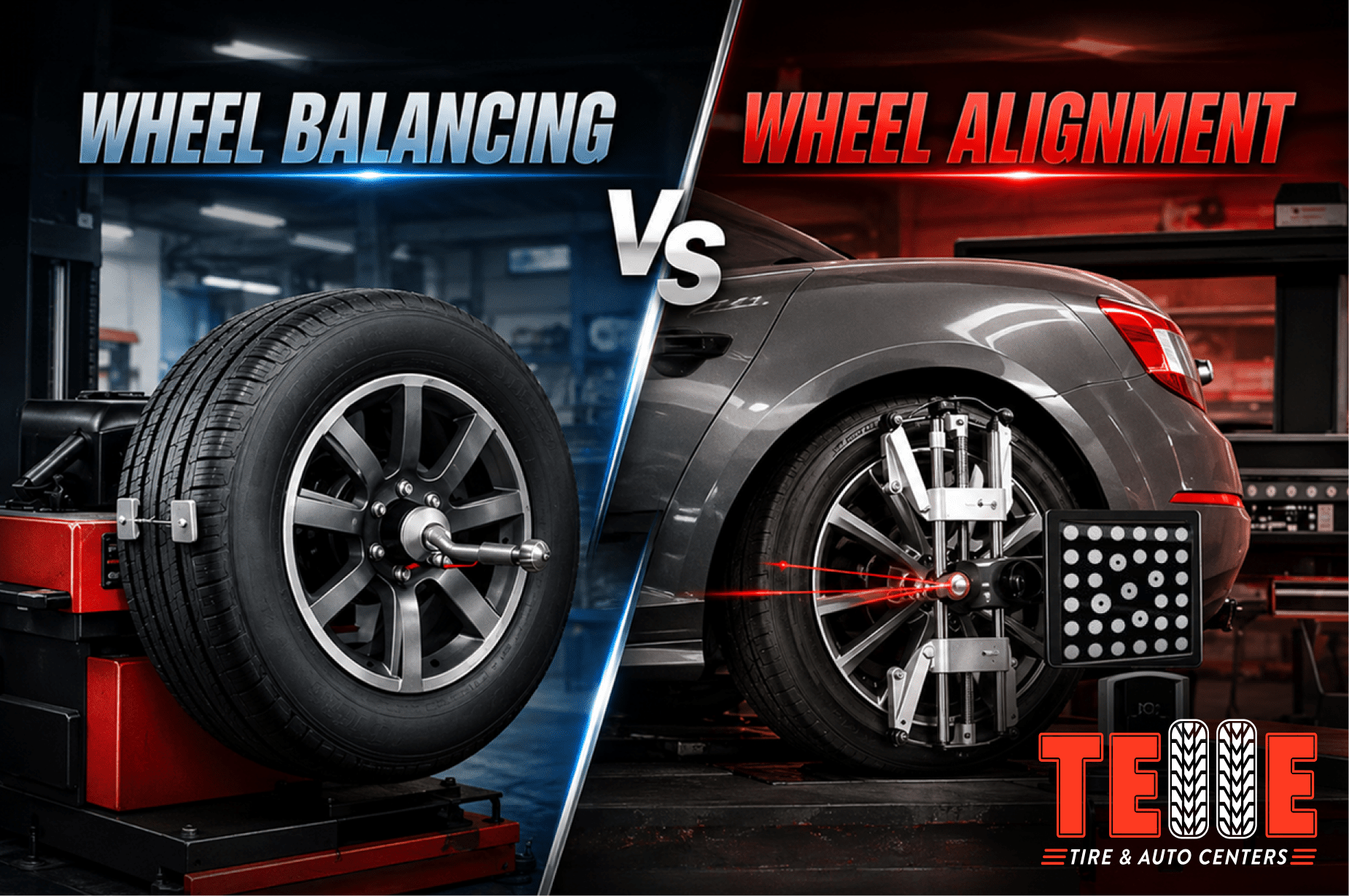
If your vehicle feels shaky at highway speeds or drifts across the road, there is a good chance your wheels need attention. Many drivers confuse wheel alignment vs. balancing because both services affect how your car handles and how long your tires last. However, they solve completely different problems.
At Telle Tire & Auto Centers, drivers often ask whether they need balancing, an alignment, or both. Understanding the difference can help you avoid premature tire wear, improve handling, and save money on repairs down the road.
According to the U.S. Tire Manufacturers Association, improper alignment can reduce tire life by thousands of miles because uneven tread wear develops much faster when suspension angles are out of spec
TL;DR – Wheel Alignment vs. Balancing Quick Guide
- Wheel alignment vs. balancing are different services that solve different tire and steering problems.
- Wheel alignment corrects your suspension angles, while wheel balancing corrects uneven tire weight distribution.
- Signs of bad alignment include uneven tire wear, a steering wheel off-center, and car pulling to one side.
- Missouri potholes, curbs, and rough roads commonly cause alignment problems for local drivers.
- Protecting your tire investment by regularly checking alignment can extend tire life and improve fuel efficiency.
What a Wheel Alignment Actually Does
A wheel alignment adjusts your vehicle’s suspension angles so the tires make proper contact with the road. Contrary to what many drivers think, technicians are not adjusting the tires themselves. They are adjusting the suspension geometry.
Modern alignment machines measure three main angles:
Camber, caster, and toe in plain English
Before deciding whether you need wheel alignment near me services, it helps to understand these terms in everyday language.
Camber – This is the inward or outward tilt of the tire when viewed from the front. Too much tilt can create uneven tire wear on the inside or outside edge.
Caster – This angle affects steering stability and how your steering wheel returns after a turn. Incorrect caster can make your vehicle feel unstable at highway speeds.
Toe – Toe describes whether your tires point inward or outward when viewed from above. Incorrect toe settings are one of the biggest causes of rapid uneven tire wear.
Ride height – Suspension height changes affect alignment readings. Worn shocks or springs can throw alignment measurements out of factory specifications.
Suspension condition – Components such as control arms, tie rods, and ball joints directly affect alignment accuracy and steering performance.
Most drivers never notice these angles until something feels wrong. However, even minor changes caused by potholes or curb impacts can affect how your vehicle drives.
Missouri drivers are especially vulnerable because freeze-thaw cycles and rough highways like I-44 and I-70 create road conditions that regularly knock vehicles out of alignment.
When alignment angles stay within manufacturer specifications, your vehicle tracks straighter, tires wear evenly, and steering feels more controlled.
Alignment vs Balancing They’re Not the Same
This is where many drivers get confused.
Wheel alignment vs. balancing refers to two completely different maintenance services.
- What wheel balancing doesWheel balancing ensures the tire and wheel assembly spins evenly at high speeds. Technicians use a balancing machine to identify heavy spots and add small weights to correct the imbalance.
- What wheel alignment doesAlignment adjusts suspension angles to ensure all four tires point correctly and contact the road evenly.
Here is the simplest way to remember alignment vs balancing:
- Alignment fixes pulling and uneven tire wear
- Balancing fixes shaking and vibration
If your steering wheel vibrates around 60 mph, balancing may be the issue. If your car pulling to one side continues on straight roads, you likely need an alignment.
Common signs you need balancing instead of alignment
Many drivers searching for wheel alignment near me actually need balancing instead.
Steering wheel vibration – Vibrations at highway speed usually indicate tire imbalance.
Seat vibration – If the vibration feels stronger through the seat or floorboard, balancing is often the culprit.
Recently installed tires – New tires should always be balanced after installation.
Uneven weight distribution – Missing wheel weights can quickly create ride instability.
Highway-speed shaking – Problems that appear only at higher speeds typically point toward balancing issues.
Balancing improves ride comfort, protects suspension parts, and helps tires wear more evenly.
5 Signs You Need an Alignment
Drivers asking “do I need an alignment” are usually already experiencing symptoms.
Ignoring alignment problems often shortens tire life dramatically.
Car pulls to one side
If your vehicle drifts left or right without steering input, your alignment may be off.
- Constant steering correction – You should not need to fight the steering wheel on straight roads.
- Uneven road response – Pulling often becomes worse after pothole impacts.
- Reduced highway stability – Long-distance driving feels tiring when alignment is incorrect.
- Increased tire stress – Tires scrub against the road instead of rolling smoothly.
- Safety concerns – Pulling affects emergency handling and wet-weather control.
Even a mild car pulling to one side issue can lead to rapid tire damage over time.
Steering wheel off-center
A crooked steering wheel while driving straight is one of the clearest signs of bad alignment.
- Wheel tilted left or right – Your steering wheel should sit centered naturally.
- Recent suspension repairs – Alignment should always follow steering or suspension work.
- Vehicle wandering – Off-center steering usually comes with poor directional stability.
- Inconsistent handling – Turning may feel uneven from one direction to another.
- Reduced driver confidence – Steering issues make daily driving less comfortable.
Uneven or rapid tire wear
Uneven tire wear is one of the biggest warning signs drivers overlook.
- Inner edge wear – Often caused by incorrect camber settings.
- Outer edge wear – Common when alignment angles are severely off.
- Feathered tread patterns – Toe problems frequently create this type of wear.
- Premature replacement costs – Misalignment can shorten tire life by thousands of miles.
- Reduced fuel efficiency – Excess rolling resistance increases fuel consumption.
Protecting your tires with regular four-wheel alignment checks can save hundreds of dollars over the life of your tires.
Vibration or loose steering
Not all vibrations come from balancing alone.
- Loose steering feel – Alignment issues can make steering feel disconnected.
- Suspension wear – Worn tie rods or control arms affect alignment stability.
- Road instability – The vehicle may feel unpredictable on rough roads.
- Steering response delay – Turning input may feel slower or inconsistent.
- Combined tire issues – Sometimes balancing and alignment problems happen together.
After hitting a pothole or curb
Missouri roads can be brutal on suspension systems.
- Pothole damage – Sudden impacts commonly throw alignment out of spec.
- Curb strikes – Parking mishaps frequently affect toe angles.
- Hidden suspension damage – Bent components may not be immediately visible.
- Steering changes – Problems often appear days after impact.
- Tire protection – Early inspection helps prevent uneven tire wear.
After major pothole impacts, it is smart to search for wheel alignment near me before tire wear becomes severe.
Do You Need an Alignment With New Tires
Yes, alignment after new tires is strongly recommended.
Many drivers invest hundreds or even thousands of dollars in new tires but skip the alignment check that protects them.
If your previous tires showed uneven tire wear, installing new tires without correcting the alignment problem means the new set will wear unevenly too.
Why alignment after new tires matters
- Protects your tire investment – Proper alignment helps tires reach their expected mileage.
- Improves ride quality – New tires perform best when aligned correctly.
- Reduces steering problems – Alignment ensures smoother handling immediately after installation.
- Prevents rapid tread wear – Incorrect alignment destroys fresh tread quickly.
- Supports warranty coverage – Many tire warranties require proper maintenance records.
At Telle Tire & Auto Centers tire installation service, technicians inspect tire wear patterns carefully to determine whether alignment correction is needed alongside installation.
How Much Does a Wheel Alignment Cost
Wheel alignment cost varies based on your vehicle type and the type of alignment required.
Most drivers will choose between two-wheel alignment and four-wheel alignment services.
Two-wheel vs. four-wheel alignment
- Two-wheel alignment – Common for older vehicles with solid rear axles.
- Four-wheel alignment – Recommended for most modern cars, SUVs, and AWD vehicles.
- SUV alignment complexity – Larger vehicles often require more detailed adjustments.
- Suspension condition – Worn parts may increase labor requirements.
- Advanced alignment machines – Modern computerized equipment improves accuracy significantly.
Typical wheel alignment cost ranges from around $80 to $150 depending on vehicle design and suspension complexity.
Although some drivers hesitate at the price, replacing prematurely worn tires costs far more than routine alignment service.
How Often Should You Get an Alignment
Drivers often ask how often wheel alignment should be performed.
There is no universal mileage rule because road conditions and driving habits matter.
However, most ASE-certified technicians recommend checking alignment:
- Once per year
- After hitting major potholes
- After suspension repairs
- When installing new tires
- Anytime steering feels abnormal
Missouri road conditions make annual inspections especially valuable.
Drivers searching for signs of bad alignment often wait too long, allowing tire damage to become permanent before scheduling service.
When to See a Professional
Some alignment issues are difficult to diagnose without professional equipment.
Modern alignment machines use laser-guided measurements that compare suspension geometry against manufacturer specifications.
At Telle Tire & Auto Centers wheel alignment and balancing service, technicians inspect:
- Suspension components
- Tie rods
- Control arms
- Steering systems
- Tire wear patterns
- Ride height measurements
If suspension damage exists, alignment alone may not solve the issue.
That is why steering and suspension inspections are often recommended alongside four-wheel alignment services.
Drivers experiencing persistent steering problems may also benefit from a full steering and suspension inspection.
FAQ About Wheel Alignment vs. Balancing
How do I know if my car needs an alignment?
Common signs include uneven tire wear, steering wheel off-center, and car pulling to one side while driving straight.
Is alignment the same as balancing?
No. Alignment adjusts suspension angles while balancing corrects uneven tire weight distribution.
Should I get an alignment with new tires?
Yes. Alignment after new tires helps protect tread life and improves handling performance.
How much does a wheel alignment cost?
Wheel alignment cost typically ranges from $80 to $150 depending on vehicle type and whether you need two-wheel or four-wheel alignment.
How often should wheel alignment be checked?
Most vehicles should have alignment checked yearly or after hitting potholes, curbs, or rough road hazards.
Protect Your Tires With Telle Tire & Auto Centers
Understanding wheel alignment vs. balancing helps drivers make smarter maintenance decisions and avoid unnecessary tire damage. While balancing smooths out vibrations, alignment protects handling, steering accuracy, and tire life. Both services matter, but knowing which problem you are experiencing saves time and money.
Missouri roads can be tough on suspension systems, especially during freeze-thaw seasons when potholes become unavoidable. If you notice uneven tire wear, loose steering, or your car pulling to one side, having your alignment inspected early can prevent much more expensive repairs later.
At Telle Tire & Auto Centers, experienced technicians use advanced alignment equipment and manufacturer specifications to help drivers get the best performance and lifespan from their tires. Whether you drive a commuter sedan, SUV, or family vehicle, proper alignment plays a major role in safety and long-term vehicle health.
Call to Action
Car pulling to one side or tires wearing unevenly? Schedule a professional wheel alignment inspection at Telle Tire & Auto Centers Schedule Service and protect your tire investment before small steering problems turn into costly repairs. Take it to Telle.

Take it to telle
Stay Safe with a Tire Check from Telle Tire
Worried about your tread depth or tire condition heading into the summer storm season? Take it to Telle. Our expert technicians can assess your tires, check pressure levels, and recommend replacements when necessary, helping you stay in control regardless of the weather conditions. Stay safe, stay prepared, and if you’re unsure about your tires, schedule a visit with your nearest Telle Tire & Auto Centers location today.
Stay Informed
Recent Articles from Telle Tire
Tennessee Vehicle Maintenance Checklist for Reliable Driving
Owning a vehicle in Tennessee means dealing with changing road conditions, seasonal weather, and daily driving demands. A reliable car does not happen by accident. It…
Tire Age Limit Explained: When Should You Replace Old Tires?
Many drivers assume tires only need to be replaced when the tread wears down. While tread depth is important, tire age is another major factor that…
Steering Wheel Shaking on Highway, Tires or Alignment?
When your steering wheel starts shaking on the highway, even a familiar drive can become stressful. You may notice the vibration around 55 to 70 mph,…